

The core idea
The goal is fewer places to enter the same information, with privacy and professional review built into the process.
The work behind the paperwork
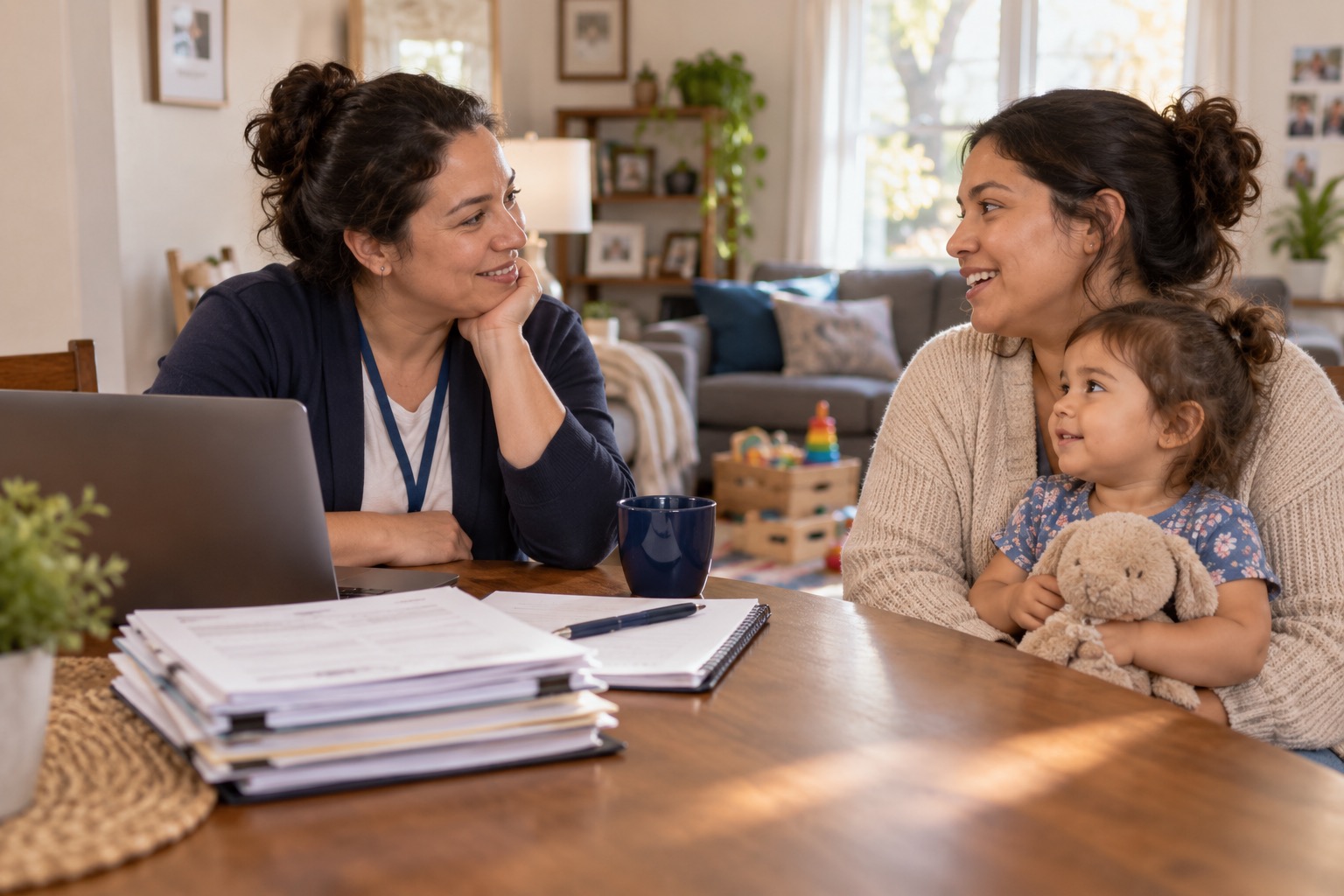
Home visiting is fundamentally a human profession, built on trust, observation, and relationship. Yet home visitors spend a substantial share of their week on documentation, assessments, and reporting instead of with the families they serve. The question isn't whether that paperwork is necessary. Much of it protects children, funds programs, and holds everyone accountable. The real question is why one person still has to retype the same family's story into three or four different systems by hand.
This isn't an argument against documentation, model fidelity, or state and federal reporting. MIECHV performance measures, PAT fidelity checks, SafeCare documentation, and state requirements all exist for real reasons: protecting children, tracking outcomes, and justifying public investment. Duplication and fragmentation are the problem, not accountability. The fact that a home visitor often has to enter the same information into several separate places before a single visit counts as "done" makes an already challenging job unnecessarily difficult.
- Home visiting is relationship-based work. Documentation should support that relationship, not compete with it for a home visitor's time.
- Research consistently finds duplicate data entry, not documentation itself, among the top sources of home-visitor stress.
- Federal reauthorization now requires HRSA to cut MIECHV administrative burden by at least 15 percent, a sign that fragmentation is a recognized problem.
- Any technology used in this space has to meet the same privacy, consent, and confidentiality standards home visitors already follow, and its outputs still need a professional's review before becoming part of the official record.
- The goal isn't less documentation. It's fewer places a home visitor has to put it.
The relationship is the work
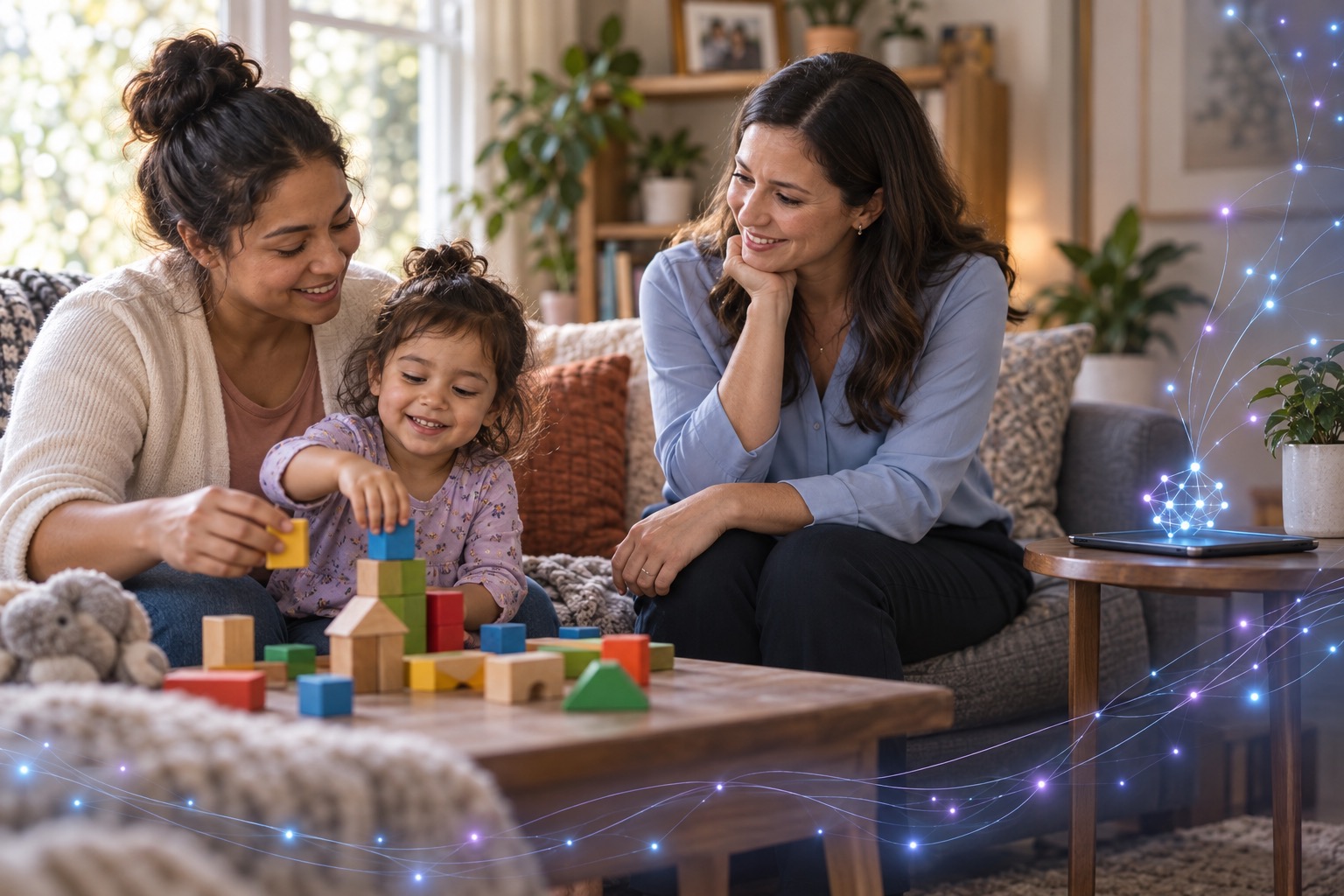
Home visitors enter people's homes. They listen. They observe. They use their awareness to notice things a questionnaire could never capture: a look between parent and child, a stack of unopened mail, a question a parent is too embarrassed to ask directly. They help families navigate developmental concerns, housing instability, behavioral issues, health needs, employment, safety, and access to community resources, all while building a relationship that has to survive weeks, months, and sometimes years of visits.
That relationship is the actual work. The administrative system around it exists to support it, not to compete with it for a home visitor's attention.
When one visit becomes several records
After the visit ends, a second job starts. It can include visit notes, assessments, family goals, referrals, follow-ups, outcome measures, mileage, scheduling, model-specific documentation, supervisor requirements, and state and federal reporting. And that information often can't just be entered once. It frequently has to be entered again, into separate systems that don't talk to each other.
A 2024 University of Delaware dissertation examining Early Head Start home visitors found that these professionals identified duplicate data entry into multiple platforms as a major source of stress, alongside a specific, labor-intensive assessment platform that nearly every home visitor named unprompted (Fuller, 2024). A separate qualitative study of Florida's MIECHV-funded home visitors found the same thing: across ten focus groups, the burden of paperwork and data entry ranked as the single highest work-related stressor (Alitz et al., 2018).
Here's what both studies point to. Home visitors weren't asking for less documentation. They understood why the data mattered. Their frustration was more specific. Why does the same family interaction have to be manually translated into three or four different administrative systems by the same person?
One family. Many reporting requirements.
A home visitor experiences a family as a whole person, a whole household, a whole set of interconnected needs. Administrative systems see pieces instead, factors like child development, family goals, visit completion, assessment results, referrals, program fidelity, funding measures, demographics, and outcomes.
MIECHV itself illustrates the pattern. Federal reporting requires demographic and service-utilization measures, a set of benchmark performance measures across areas like maternal health and child development, and specific rules for documenting and explaining missing data (HRSA, MCHB). Layer a home visiting model's own fidelity requirements on top of that, and a home visitor becomes the person manually stitching every piece of data they have together again and again.
The process of collecting this data and telling a family's story is valuable and necessary. However, the primary value comes from doing it the first time. Repeating the process across various systems is an energy drain and a poor use of the home visitor's time and skill set.
The human cost of duplication
This isn't only an efficiency problem. It's a human problem.
Other national workforce research has found that after low pay, the top reason home visitors leave their jobs is work-related stress driven by burnout or heavy caseloads. This feeds a cycle where the people who stay inherit the caseloads of the people who left (Sandstrom et al., 2020).
Every hour spent re-entering the same visit note into a second or third system is an hour that could have gone toward preparing for the next family, following up on a referral, or simply being present. The real cost of duplication isn't the paperwork, but everything it inherently displaces.
Another login is not the answer
It might seem like the fix is obvious. Just build another platform. But if a new tool means another login, another database to keep updated, and another workflow to learn on top of the ones already in place, it can make the problem worse rather than better.
Even the federal government has landed on this conclusion. Under its 2022 reauthorization, MIECHV is now required to cut administrative burden for state and local awardees by at least 15 percent by eliminating duplicate reporting requirements and streamlining data collection across systems (HRSA, MIECHV Program Reauthorization). That requirement indicates that duplicated reporting, not insufficient reporting, has been the real problem all along.
The better question isn't "what's the next app?" It's whether technology can become the connective layer between a home visitor and the systems they already have to satisfy, rather than one more system added to the pile.
Separately, the 2018 Bipartisan Budget Act directed HRSA to establish standards for exchanging data between home-visiting programs, other state systems, and federal agencies, and federal researchers have been studying how to make that exchange happen with less burden on the people entering the data in the first place (ACF, Office of Planning, Research and Evaluation).
What if the future of home-visiting technology isn't one giant system replacing everything? What if instead, it's an intelligent layer that helps the systems already in place work together securely, without needing a person to be the manual bridge between them?
A more connected working day
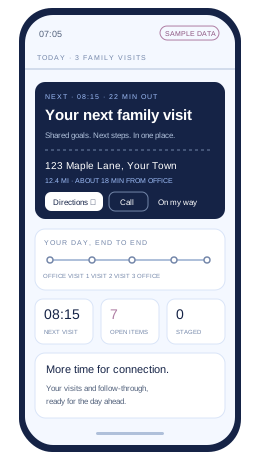
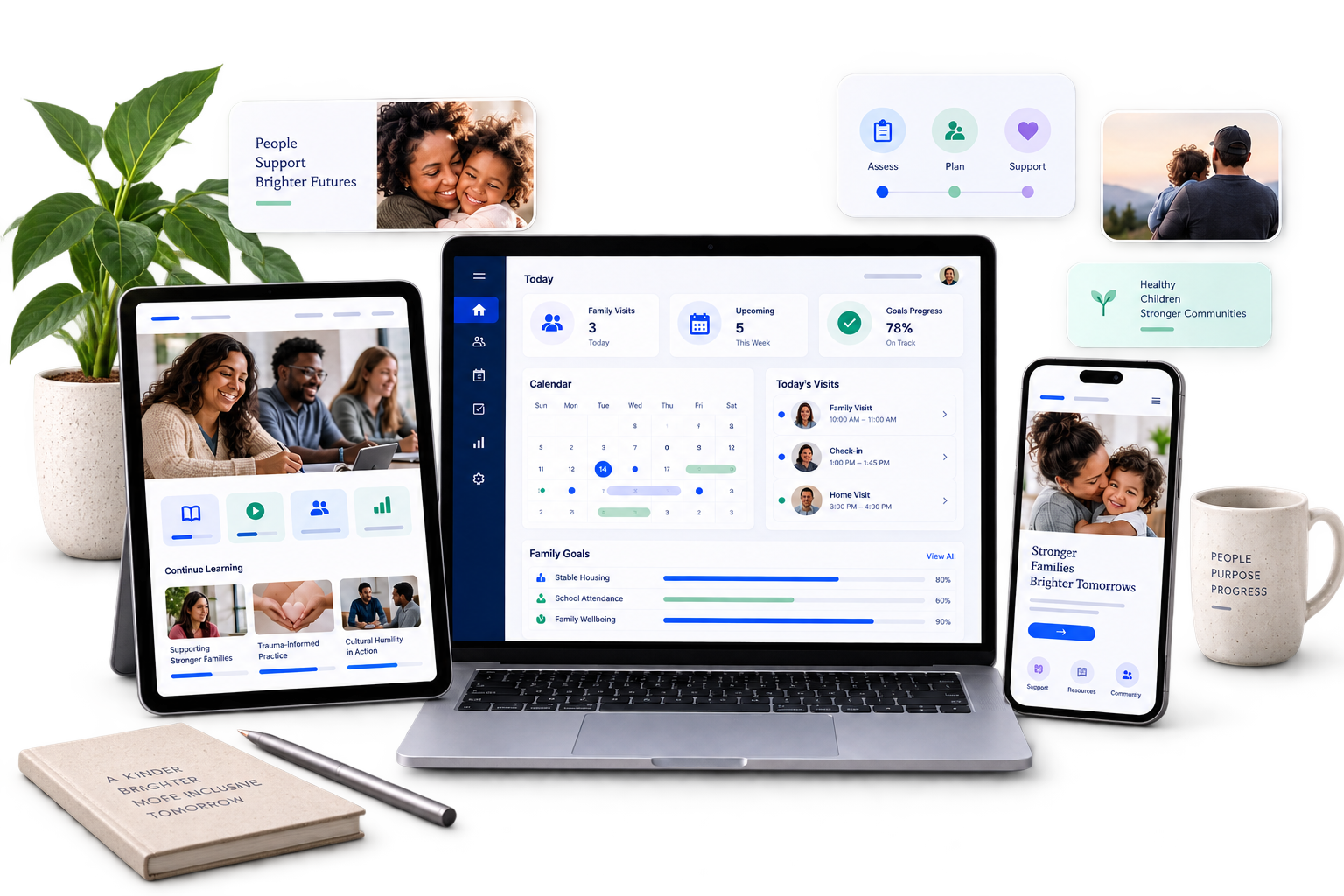
Picture a home visitor preparing for tomorrow's visit with one platform that puts the most important information front and center, like the family's previous goals, upcoming milestones, any missing assessments, needed follow-ups, recent referrals, and relevant program requirements. No need to piece it together across three separate logins.
After the visit, instead of reconstructing the conversation from memory later that night, technology could help organize the notes that were actually taken, flag what's missing, draft the documentation, and map it to the fields each required system needs.
The home visitor still reviews and approves every bit of it before it becomes part of the record. That review isn't a formality. It's the point. Technology can prepare a first draft. Only a trained professional can judge whether it's accurate, complete, and true to what a family actually said.
An assistant, with professional judgment at the center
There's real opportunity here to help home visitors achieve their main objective: to help families. An AI administrative assistant that can help summarize, organize, retrieve, remind, cross-reference, and draft could be immensely useful.
There is no need for an AI caseworker, an AI social worker, or any kind of automated decision-maker standing in for a home visitor's judgment. Every judgment call, every relationship, and every interpretation of what a family needs should stay with the person in the room. An assistant that can help with the paperwork, though, could be indispensable.
Protecting the trust behind every record
It's also important to consider what's in a family's file. Case notes, assessments, and referrals often include some of the most sensitive information a family will ever share, like health history, custody questions, and safety concerns. Any technology touching that data has to meet the same confidentiality standards home visitors are already required to meet, and families deserve to know when a tool is assisting with their file. Improving the efficiency of documentation doesn't mean loosening those standards. They just have to be applied to any new tools and processes moving forward.
More time for the reason they chose this work
Good documentation protects families, professionals, programs, and the public investment behind all of it. What needs to change is asking highly trained people to perform administrative work that better-designed technology can help them accomplish, so the hours they get back go toward the reason they took the job in the first place.
Home visitors chose this profession to work with people, not systems. The next generation of home-visiting technology should be judged by one simple question: does it give them more time to do exactly that?
At Mophead Media, we're exploring this challenge through an early-stage technology initiative built around a simple question: how can we give home-visiting professionals more time for families while helping programs meet increasingly complex documentation and reporting requirements?
