


The core idea
AI can assist with drafting and repetitive tasks. People remain responsible for decisions, accuracy, relationships, and care.
Technology in service of people
AI does not replace nonprofit professionals. It removes the repetitive administrative work (documentation, reporting, translation, research) that keeps them from spending time directly with the people they serve. For decades, nonprofit staff have been asked to do more with less: bigger caseloads, more paperwork, higher funder expectations, smaller budgets, fewer hands to share the load. AI changes how much of that work gets done in a day. It does not change the heart of the work itself.
This isn't just a hunch. Researchers who reviewed over a hundred studies on human-AI collaboration found that the biggest gains showed up in content-creation work: drafting, writing, and documentation. Decision-making, on the other hand, is still best left to people. That split maps almost exactly onto how AI should show up in nonprofit work: doing the drafting, never the deciding. (Nature Human Behaviour, 2024)
- AI's role in nonprofits is to clear away repetitive tasks (notes, reports, translations, research), not to make decisions on behalf of staff.
- Human judgment, empathy, and relationship-building remain entirely with the professional; AI has no role in those.
- The professionals who benefit most: case workers, home visitors, educators, therapists and family support specialists, program managers, fundraising teams, and instructional designers who run training programs.
- Time saved on paperwork converts directly into more time with the families, students, and clients a nonprofit serves.
- In child welfare and human services specifically, any AI tool has to meet the same privacy, consent, and confidentiality requirements the humans already follow, and its output still needs a professional's review before it becomes part of an official record.
This shift matters because people rarely choose nonprofit work for the paperwork. They do it because they care about people: helping a child feel safe, helping a parent build confidence, helping a community grow stronger. When AI takes over the repetitive parts of the job, it gives those same professionals more room to do the work that drew them to the field in the first place.
Case workers: less repetition, more attention
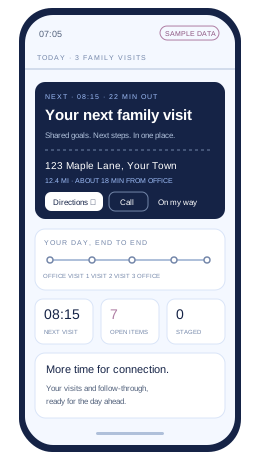
AI helps case workers by summarizing visit conversations, organizing notes into documentation, flagging missing information, translating materials, and suggesting resources. But it still leaves the final decisions for the case worker.
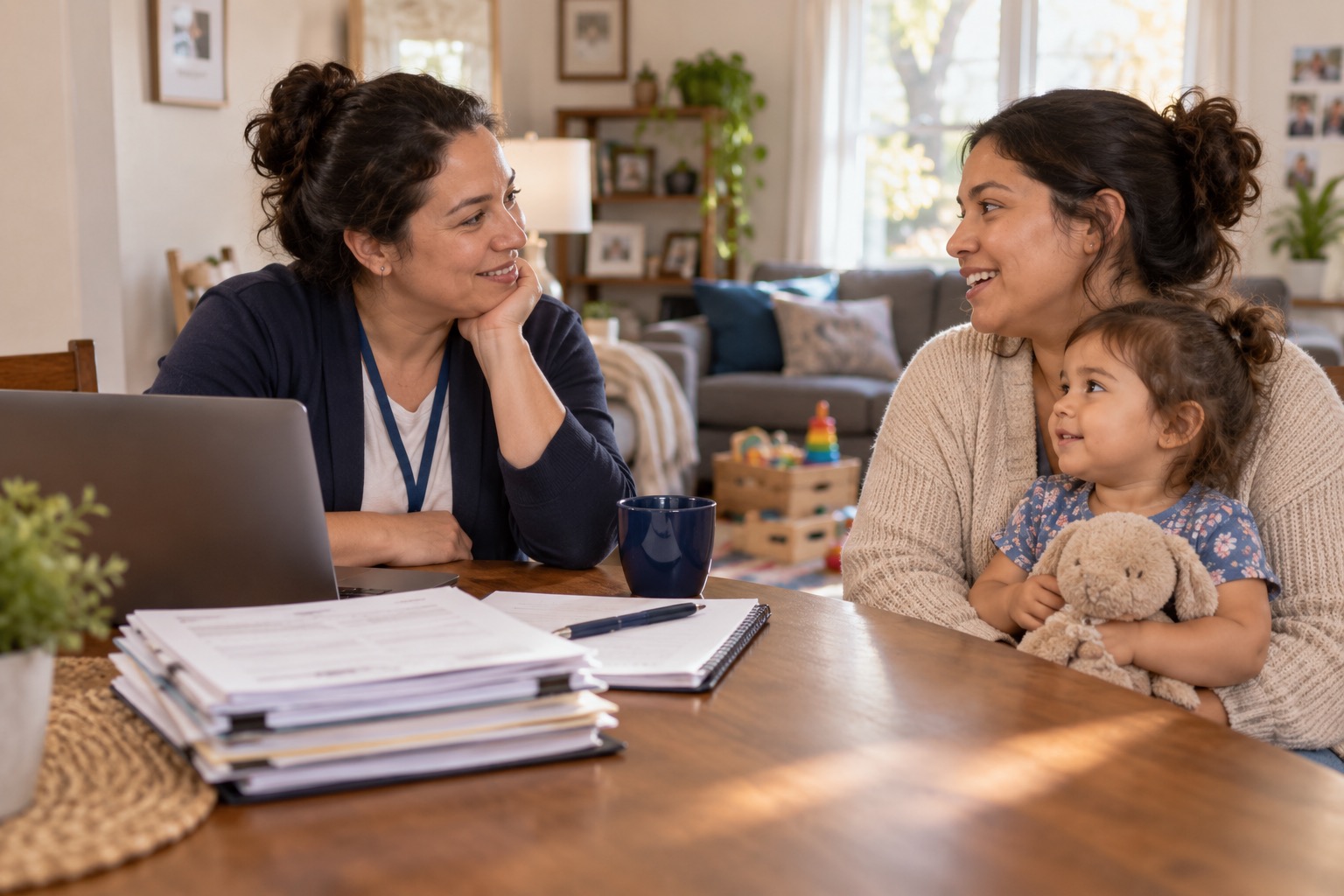
Case workers tend to be very busy people, carrying heavy caseloads and required to do more than any one person can. They visit families, write reports, research resources, and prepare for the next visit, often with very little time in between.
So many of them carry caseloads well above what child welfare experts consider sustainable. On a typical day, they might drive to three or four home visits, then spend two or three more hours turning notes into formal reports back at the office. This is time that could otherwise go toward thinking through each family's situation. With AI drafting the report immediately after a visit, that same case worker can finish documentation in the car, while details are still fresh, and arrive at the next visit with a clear head instead of a backlog.
None of this works without guardrails. Case files hold some of the most sensitive information a family will ever share: allegations, custody details, health and mental health history. Federal law under CAPTA requires states to keep that information confidential and to spell out exactly who can access it and when (Child Welfare Information Gateway). Any AI tool touching case data has to meet those same confidentiality standards, and families should be told when AI is assisting with their file.
AI can draft a summary or flag a missing form, but it cannot judge whether a home is safe, whether a family's account holds together, or whether a situation needs to go to a supervisor right now. Those calls stay with the case worker, and every AI-generated note or flag still needs a human to review it before it becomes part of the official case record.
The less time they spend on forms, the more time they can spend with families who need help.
Home visitors: more room for connection
AI supports home visitors by drafting visit summaries, organizing notes, suggesting age-appropriate activities, translating handouts, and tracking family progress toward goals, all while the home visitor remains the one building trust and making care decisions.
Home visitors build relationships with families over weeks, months, and sometimes years: teaching parenting skills, sharing child development guidance, and connecting families to community resources. What most people don't see is everything that happens after the visit ends: notes, assessments, referrals, follow-up plans, and strict grant reporting requirements.
A home visitor leans on AI mostly for what happens after they leave a family's living room. They can use it to draft a visit summary while details are still fresh, turn scattered notes into cohesive documentation, or create a report for supervisors or funders.
AI also handles some of the thinking that used to require a reference binder. Things like suggesting age-appropriate activities based on where a child is developmentally, pointing to community resources that fit a family's specific situation, pulling in research relevant to what a family is going through, and drafting handouts and custom activities in whatever language a family actually speaks. These can be ready for the home visitor to check before anything goes out the door. A family's progress toward their own goals gets tracked over time too, so a home visitor walks into each visit already knowing where things stand instead of paging back through months of notes.
Home visiting depends on family-centered practice. Goals and pace are set by the family, not dictated by a program's paperwork requirements. AI can help organize a visit summary, but the home visitor still decides what belongs in it and whether it reflects what the family actually said, not just what an algorithm assumes matters.
Consent matters here too. Home visiting programs like Minnesota's Family Home Visiting initiative, funded in part through the federal MIECHV program, require written, informed consent from families before their data is shared with the state or an outside evaluator (Minnesota Department of Health). Home visitors need clear direction from their agency about which AI tools are approved and how families are told their information may be used. The relationship, and the trust it depends on, still belongs to the home visitor and the family.
Picture a home visitor working with a Spanish-speaking mother. Without AI, a translated handout on infant sleep safety might take days to put together, or get skipped entirely for lack of time. With AI, that same handout can be ready in minutes, in the language the family actually uses at home.
Teachers: support for individual learning
AI helps teachers personalize instruction at scale by drafting lesson plan variations for different reading levels, translating handouts, and generating practice problems matched to individual students, ready for the teacher's review in minutes rather than hours.
Good teachers already personalize learning for every student; AI makes that possible for an entire classroom at once rather than just a few students at a time. Take a teacher with thirty students spread across several reading levels. Building one differentiated worksheet used to take the better part of a planning period, so most teachers had time to make just one version and hoped it worked well enough for everyone. With AI drafting the variations, that same teacher can produce five versions, each matched to where a specific student actually is, in roughly the time it used to take to make one.
That gap matters because a teacher's day was already stretched thin before adding differentiated materials to the pile. The average teacher works about 54 hours a week, and less than half of that time goes to direct instruction, with the rest split between grading, planning, and administrative work (EdWeek Research Center, 2022).
None of this replaces the teacher. AI cannot notice a student is upset before class or celebrate with a child who finally grasps a concept they'd struggled with for weeks. It handles the busywork so students get more of the teacher's direct attention.
Family support: space to be present
AI supports therapists and family support professionals by organizing session notes, summarizing key points, and surfacing relevant research, freeing the professional to stay fully present during the conversation instead of splitting attention with a notepad.
Empathy, listening, and trust cannot be automated. These remain entirely human. But therapists and family support professionals still spend hours on tasks unrelated to that human connection, like writing session notes, researching supporting evidence, and preparing client-facing materials. Any AI tool involved in that work, even one that only takes notes, still needs the client's informed consent and has to meet the same privacy and security standards as the rest of the client's record.
This burden shows up in the numbers. The American Psychological Association's 2025 Practitioner Pulse Survey found that 34% of psychologists report feeling burnt out, and among those already using AI in their practice, more than half use it for writing assistance and nearly a third for summarizing notes, a reminder that reducing time spent on paperwork isn't just an efficiency question (APA, 2025). It's a retention one.
Consider a family support specialist meeting with a mother searching for stable housing. When AI handles note-taking afterward instead of during the session, the specialist can give that mother full, undivided attention, asking better follow-up questions and catching details that multitasking would have missed.
Technology handles the paperwork while professionals provide the care.
Program managers: a clearer view of the work
AI helps program managers by consolidating scattered data, surfacing trends, drafting funder reports, and flagging warning signs early. This helps turn a task that used to take a week into one that may take an afternoon for the program manager to finalize.
Program managers often spend their days chasing down information scattered across emails, spreadsheets, and systems. AI can pull that information into one place and surface trends a person would need hours to find manually. For example, flagging a drop in attendance at one program location immediately, rather than at the end of the quarter when it's too late to act.
There might be a funder report that used to take a full week to prepare with the need to pull numbers from five different systems and format them by hand. With AI drafting it, that same report can come together in a single afternoon, ready for the program manager to review and send. That freed-up time goes back into the program: more site visits, more staff coaching, more forward planning instead of just keeping up.
Fundraising: more time for relationships
AI speeds up grant writing by identifying matching funding opportunities, summarizing funder priorities, and drafting proposals for human review, letting fundraisers spend more time on relationships and less on repetitive drafting.
Writing a strong grant application has always taken time. A lot of effort goes into researching funders, understanding their priorities, drafting, and revising to fit each funder's specific requirements. AI can speed up nearly every step: identifying opportunities that match a mission, summarizing what a funder has historically prioritized, preparing a first draft, tailoring the same core story for different audiences, and organizing supporting outcome data.
Imagine a two-person fundraising team juggling twenty grant deadlines a year. With AI handling first drafts and research, they no longer have to choose between writing a strong proposal and finding new funders to approach, and can pursue more opportunities without sacrificing quality on any single one.
Fundraisers still tell the organization's story. No AI tool replaces the passion a fundraiser brings to describing the families a program has helped.
Training: keeping learning current
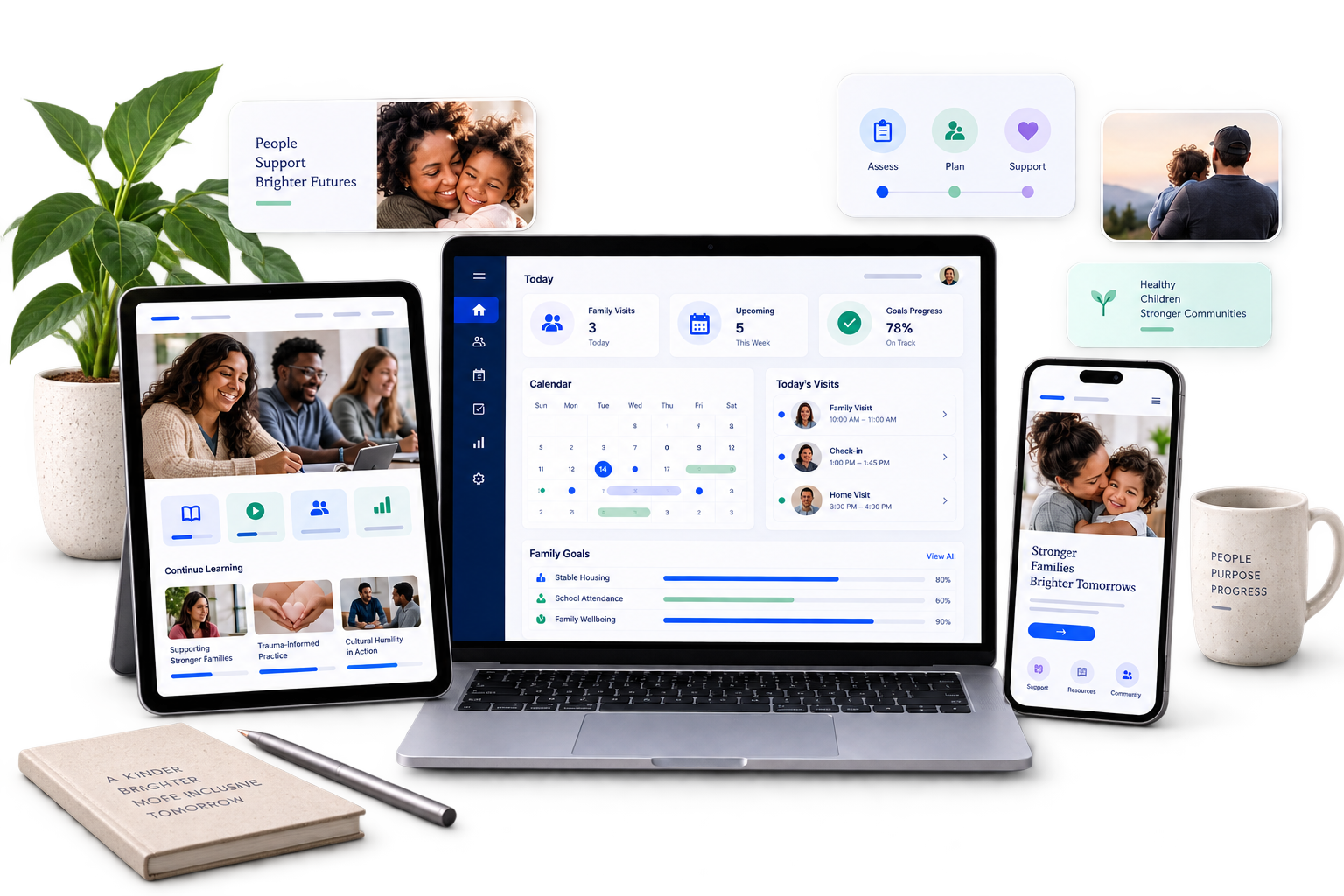
AI-powered learning management systems help nonprofit training stay current by flagging what needs updating when policies change and drafting the revised content, quizzes, and translations for an instructional designer to review, cutting update cycles from months to days.
Traditional training platforms often become static libraries of outdated videos and PDFs, since updating content usually takes months of planning. An AI-powered training platform can:
- Flag course content that needs updating as soon as policies change, and draft the revisions for an instructional designer to approve
- Create draft quizzes and case studies in minutes instead of weeks, for a designer to finalize
- Recommend adjustments to each learner's path based on their progress
- Draft translated versions of courses in multiple languages, for a reviewer to confirm the meaning holds up
- Build separate versions of the same training for supervisors, frontline staff, volunteers, and administrators
- Create realistic scenarios staff can practice and discuss
- Turn passive videos into interactive lessons
- Help instructional designers build graphics, narration, and animation faster
- Help pilot entirely new courses in days instead of months, with staff feedback still shaping final approval
Consider what happens when a state changes a reporting requirement for child welfare staff: a traditional update cycle might take three to four months, during which staff work from outdated information. An AI-powered system can flag the change and draft the updated material within days, so an instructional designer can review it and get staff trained on the current rules much sooner than before.
Instructional designers don't become unnecessary. They become more productive, spending time on the creative and judgment-driven parts of course design instead of manually rebuilding each piece.
Capacity for the mission
The greatest promise of AI in the nonprofit sector is not replacing professionals. It's expanding what they're able to do. Every hour not spent copying data between systems is an hour available to mentor a struggling parent. Every report that takes minutes instead of hours means more time to help a child. Every automated task gives a program manager more time to improve outcomes instead of managing spreadsheets. Every faster training update means staff get better training, sooner.
None of this happens automatically. Organizations still need to choose the right tools, train staff to use them well, and set clear rules for how AI fits into their work. But for nonprofits willing to take that first step, the payoff is real: more time, more capacity, and more energy for the mission that brought everyone to the work in the first place.
AI works best when it stays in the background, quietly handling repetitive work so people can focus on what only a person can do. It takes real people to build trust, show compassion, solve hard problems, strengthen communities, and change lives.
That is the future we believe in at Mophead Media. Not technology for technology's sake, but technology that supports the people who are already making the world better. Technology should amplify compassion, not replace it.